.
The Shetland Islands lie on the 60 degree North line of latitude. According to a local song, there are a hundred Shetland Islands that range from the biggest island – which we call the Mainland – to tiny green holms you might spot in the distance. Of these hundred isles, just 16 are inhabited all year round.
And even though the islands are on the same latitude as St. Petersburg in Russia, Horseshoe in Alaska or Whitehorse in the Yukon the climate is mild – thanks to the Gulf Stream which warms our waters.
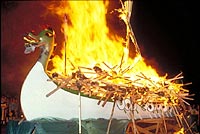
The Vikings came to Shetland sometime around the early ninth century and Norse rule prevailed for the next 600 years. Shetland only became a part of Scotland in 1472 and to this day we are immensely proud of our Norse heritage manifested in the dialect, in place names, and the annual Up Helly Aa fire festival celebrations.
Within Shetland some islands are linked to the Shetland Mainland by bridges. And ferries to the Northern isles, such as Yell, Unst and Fetlar run to a regular timetable, booking is essential. The outlying islands of Fair Isle and Foula also have a scheduled air service which operates from Tingwall Airport.
There is a network of 1,000 miles of high quality roads that are rarely busy – so you can take your time to enjoy the stunning views that await you at every twist and turn.
Shetland has a population of about 23,000 people, approximately a third of those live in Lerwick, the main town.
With a coastline of close to 2,000 miles there are countless beautiful beaches and an abundance of spectacular cliff scenery. In the breeding season (May-August) hundreds of thousands of seabirds make their homes around our shores and you could find yourself within feet of our loveable puffins. Many ornithologists, including some of Britain’s best known experts, have come to Shetland to see our seabirds.
There’s also a good chance you may spot various species of whales, dolphins and porpoises around our shores. And seals can be commonly seen – even on a short stroll around the outskirts of Lerwick and sometimes even playing in the harbour.
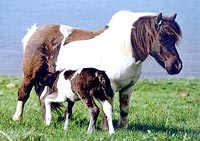
Of course, Shetland Ponies are a must for every visitor. You’ll find many of these loveable windswept Shetland ambassadors roaming the countryside. But if you’d like a closer look, your Shetland Guide may be able to arrange a visit to one of the stud farms where you can get an in-depth introduction to Shetland Ponies and meet them close-up. Remember that May is the foaling season!
As you roam the islands, you’re likely to see Otters Crossing road signs. However, actually seeing an otter may be a little more difficult. It requires time, and patience, but the effort is worth it to spend a bit of time with these elusive creatures.
You’ll also see the native, multi-coloured Shetland sheep which produce the very finest wool. The Shetland Museum and Archives have a fine display on traditional Shetland knitting – from the famous Fair Isle jumpers to the gossamer-fine lace reserved for Weddings and Christenings – that, amongst other exhibits, will give you a great view into life present and past on Shetland. Both traditional and modern knitwear designs are for sale at a selection of local outlets.
On the uninhabited island of Mousa a 2,000-year-old double walled stone tower or Broch remains virtually intact and unique as the only structure of its type in Shetland and indeed Scotland still standing. Tiny, shy storm petrels nest in the walls of the Mousa Broch and can be seen during the ‘Simmer Dim’ – the Shetland summer twilight when it never really gets dark up here.
Other ancient sites like the world-famous Jarlshof date from Neolithic times onwards and take you on an enthralling journey through time from the Stone Age to the period of the Scottish Lairds.
Or there is Old Scatness, another important multi-period archaeological site containing Shetland’s and indeed Scotland’s oldest known Broch, together with excellent examples of Iron Age Wheelhouses. The site also provides a fascinating glimpse of how the Vikings populated existing Iron Age settlements.
More recent history tells heroic stories of the Shetland Bus, a secret operation based in Shetland during World War II, and its vital contribution to the Norwegian resistance after the occupation of Norway in April 1940.
Shetlanders can certainly look back on a colourful and varied past. But in recent years we have enjoyed a prosperous and buoyant economy with near full employment. Fishing, aquaculture, agriculture, the oil industry, wind energy, knitwear and tourism all play their part. We have always valued the importance of the home-based activities which have produced our world famous Fair Isle knitting and our delicious seafood and lamb. In recent years these activities have moved beyond the home into a flourishing local economy, including new industries such as mussel-farming for which Shetland is gaining international recognition.
Our Islands have always moved with the times and today Shetland is a delightful blend of old and new. In our schools children can learn to play traditional fiddle tunes, while simultaneously using the most up-to-date tech. Although we have a small population we are proud to live in a multi-cultural community with residents from all around the world. So whether you plan to stay for two days, two weeks, twenty years, or a lifetime – Shetland and Shetland Tourist Guides warmly welcome you.